History


More History
Park Avenue 30th Anniversary Celebration
More History
For years the members of the Armstrong Avenue Church of Christ had a dream to expand its influence in Denison and a significant part of that dream included a new facility that would accommodate that vision. That aspect of the vision found its fulfillment on that winter morning in 1987. Yet, the Armstrong Avenue congregation itself had a long history in Denison dating back to the early years of the twentieth century. The origins of the Armstrong congregation are in many ways shrouded in mystery and lost in the annals of history, but this one thing is sure — when we talk about the Park Avenue Church of Christ we are actually talking about hundreds upon hundreds of believers over the decades who have laid the foundation for this great church and have invested countless hours of service to build it to what it is today.
As I sit in my office reflecting on the history of this body of Christ I can’t help but feel indebted to and inspired by all those who came before me. Through difficult times and treacherous transitions, this church has, by the power of a spirit of unity, preserved and even prospered. Through the dedicated service of ministers, elders, deacons, Bible class teachers, and servants of all kinds, Park Avenue stands as a testament to Jesus’ declaration that nothing, not even the gates of Hell, will be able to overcome a church built on the confession of Jesus Christ as Messiah!
And that indeed has been what has held us together after all these years – the enduring truth that Jesus is the Christ, the Son of God. This truth is part of our DNA. This reality is what we are all about. In a sense our name says it all – regardless of where we meet, we are the church of Christ.
Church – an assembly of people
of – belonging to
Christ – Son of God, Savior
As long as we remain faithful to who we are I suspect that many more histories of this church will be written. I anticipate that many more hundreds of people will continue to build upon that foundation set over one hundred years ago. And I hope that the generations that follow will come to feel the same sense of indebtedness and inspiration I feel today.
Todd Catteau
Preacher, Park Avenue Church of Christ
The Churches of Christ in Denison
The following history appeared in the Denison Herald in 1972 as part of a larger feature on the Churches of Christ in Denison. It is presented here in part.
Church of Christ Started Here in 1889, Expanded Three Times
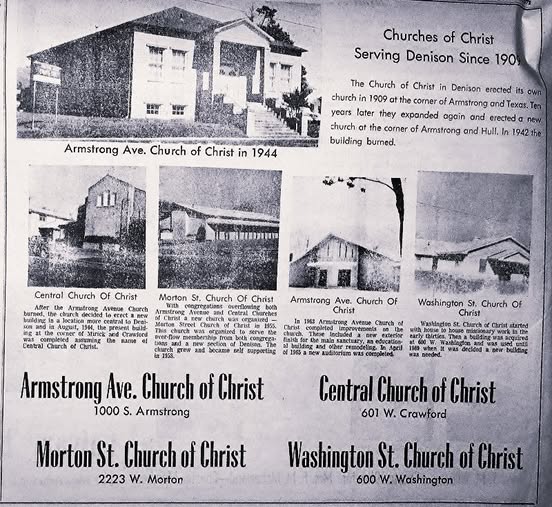
The Church of Christ in Denison began in 1889, when a group of members left the Christian Church after instrumental music was introduced into its worship. Since then, steady growth has led to three separate congregations: one on Armstrong Avenue, one at Mirick and Crawford, and one on West Morton.
Several elders of the Christian Church, among them Charles Parish and Dr. and Mrs. Williams, considered the use of instruments too progressive a change. Led by these elders, the group leased a building at 801 West Owings that belonged to St. Joseph's Catholic Church. When that building was sold, the congregation moved its meetings to the home of Mr. and Mrs. Parish at 730 West Morgan. Once membership outgrew the house, services moved to 430 West Morgan.
In 1907 the congregation bought a lot at Armstrong and Hull and built its first church, a small frame building. Ten years later it was remodeled and enlarged at a cost of about $17,000. The congregation continued to grow there, eventually reaching about 350 people, until fire destroyed the building on February 14, 1942.
While planning to rebuild, the members worshiped at the American Legion building. They could not agree on a site, however. Some favored a more central location at 601 West Crawford, while others wanted to stay at Armstrong and Hull, and the congregation divided.
Central Church of Christ
In 1943 the Central group bought a lot at Mirick and Crawford, but building proved difficult. With World War II underway, the congregation could not obtain priority for construction materials. Refusing to give up, members bought old houses and barns and salvaged enough lumber and materials to build the church. The first services at the Central Church of Christ were held in 1944, with Austin Siebert as minister.
After several smaller building projects, the wartime building was extensively remodeled in 1962. A new auditorium and classrooms were added, raising the seating capacity to 480. Membership currently stands at about 300.
The church parsonage was moved from 1327 West Chestnut to 1916 West Acheson. Paul Reddin became minister in 1970.
The congregation's first elders were J.H. Kent, F.W. Irwin, and A.P. Sims. A 1971–1972 report listed Irwin as the oldest member. The 1972 elders were H.R. Ballou, Hubert Sweet, J.B. Holland, and S.W. Womack.
Armstrong Church of Christ
The Armstrong congregation faced the same shortage of materials. Its minister, Leland Alton, was also a carpenter and contractor, and under his direction the church secured some materials through government priority while the members did the construction work themselves. The building was dedicated on August 6, 1944. It cost about $18,000, but it had no pews, and several areas remained unfinished for lack of materials.
In 1955 the church was remodeled for about $50,000, adding an educational building and classrooms. A still larger expansion was completed ten years later, bringing the property's total value to roughly $300,000.
A 1971–1972 report listed Mrs. Myrtle Shiflett and Mrs. Drucilla Williams as the oldest members. The 1971–1972 elders were Argalis Anderson, A.F. Hoover, Robert E. Monroe, Chester Walker, and Ira T. Wright.
Morton Street Church of Christ
As both congregations kept growing, a site for a third church was chosen at 1732 West Morton in 1955. Sponsored jointly by the Armstrong and Central churches, the Morton Street Church of Christ was completed and soon had a congregation of its own numbering 150. Johnny Jackson served as its first minister, and Ronald D. Henson arrived in 1970.
Following its most recent remodeling, the Morton Street church seats about 250 people and has 21 classrooms. Its total value is well above its $50,000 construction cost. The 1972 elders were Austin Mitchell, Tommy Pickerell, and Lyle Yeargin.